

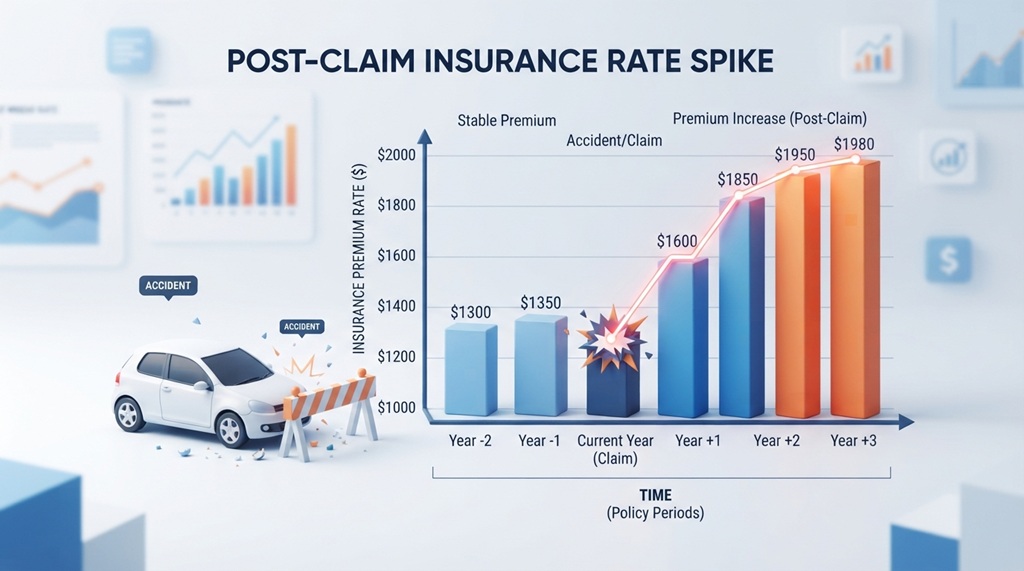
Your auto insurance rate went up because insurers treat every claim as new evidence of risk. Once you file a claim, the insurer recalculates the odds that you will file another one. In most cases, that math points to a higher premium at your next renewal.
This does not mean every claim triggers a hike. Some claims raise your rate a little. Others barely move it. A few can double your premium overnight. The size of the increase depends on fault, claim type, your state’s insurance laws, and your own claims history.
Below, we break down exactly why insurers raise rates after a claim, how long that increase sticks around, and what legal options you have if the spike seems unfair or excessive.
Why Insurers Raise Rates After a Claim
Insurers raise rates after a claim because a paid claim is a direct signal of future risk. Actuaries build pricing models on one core idea: past behavior predicts future behavior. A driver who filed one claim is statistically more likely to file another.
Every insurer maintains a database of past claims tied to your driving record. This database, often shared through a service called the Comprehensive Loss Underwriting Exchange (CLUE), lets insurers see your claims history even if you switch companies. A new claim adds a data point that pushes your risk score upward.
Rate increases are not personal. They are the output of an actuarial formula. That said, the formula does not treat all claims the same way, which is why the size of your increase can vary so much from one policyholder to the next.
How Fault Affects the Size of the Increase
Fault is one of the biggest factors in how much your rate rises after a claim. If you were found at fault for an accident, expect a larger increase than if the other driver was responsible. Insurers view at-fault accidents as stronger evidence that you personally pose a higher risk behind the wheel.
At-Fault vs. Not-At-Fault Claims
An at-fault accident claim often raises premiums by a noticeable percentage at renewal, according to industry experts who track insurance pricing trends. A not-at-fault claim, where another driver caused the crash, typically causes a smaller increase or none at all in many states.
Some states and insurers offer “accident forgiveness” programs. These programs waive the first at-fault accident surcharge for drivers with a clean record. Coverage terms vary widely, so check your policy documents or ask your agent directly.
Comparative and Contributory Negligence Rules
Fault determination itself depends on your state’s negligence laws. In comparative negligence states, fault gets split by percentage between drivers. In contributory negligence states, being even slightly at fault can bar you from recovering damages from the other driver. These legal distinctions affect how your insurer classifies the claim, which in turn affects your rate.
Which Types of Claims Cause the Biggest Spikes
Not all claims cause the same jump in price. Bodily injury and comprehensive theft claims tend to trigger larger increases than minor property damage claims. The dollar amount of the payout also matters. A claim that costs the insurer more money generally leads to a bigger premium adjustment.
- Bodily injury claims: These carry the highest average payouts, so they often produce the steepest rate increases.
- Collision claims: These vary based on fault and repair cost, and at-fault collision claims usually raise rates more than comprehensive claims.
- Comprehensive claims: These cover non-collision events like theft, vandalism, or weather damage, and typically cause smaller increases since fault does not apply.
- Multiple claims within a short period: Filing more than one claim within a few years signals a pattern to insurers, which can compound your rate increase significantly.
How Long a Claim Stays on Your Record
A claim typically affects your rate for three to five years, though this varies by insurer and state. Most insurers gradually reduce the surcharge each year you remain claim-free, until it disappears entirely.
The claim itself may still show up in CLUE reports for up to seven years, even after it stops affecting your premium. This means a new insurer could still see the claim on your record, even if your current insurer has already stopped charging you for it.
If you switch insurers, ask the new company directly how far back they look at claims history. Policies differ, and this detail can meaningfully change your quote.
How State Laws Limit Post-Claim Rate Increases
State insurance regulations heavily influence post-claim rate adjustments, as each jurisdiction enforces unique statutory guidelines governing when and how much carriers can increase premiums. Because auto insurance is regulated strictly at the state level in the United States rather than by federal law, policyholder protections and rate-lock thresholds vary significantly depending on your location meaning a single claim might trigger a steep surcharge in one state while remaining protected under a first-offense allowance in another. However, if an incident is severe enough that your vehicle is written off completely, the financial outcome shifts from standard surcharge formulas to actual cash value negotiations; understanding auto insurance handles total loss payouts helps clarify how carriers determine your vehicle’s baseline market value before any subsequent policy rate adjustments take effect.
Filed Rate Schedules and Public Records
In most states, insurers must file their rating plans with the state insurance department before using them. These filings set out exactly how much a claim, ticket, or other factor can raise your premium. In many states, these filed rate schedules are public record, which means you or your attorney can request them to check whether your increase matches the insurer’s own approved formula.
Your Right to Request an Explanation
Many states require insurers to provide a reason for a rate increase or policy non-renewal upon request. If your rate jumped by an amount that seems disproportionate to the claim, you generally have the right to ask your insurer for a written explanation. If the explanation does not add up, you can file a complaint with your state’s department of insurance.
When a Rate Increase May Cross Into Unfair Practice
Some rate increases may violate state unfair claims practices acts, particularly if the insurer raised your rate based on inaccurate claim classification or failed to follow its own filed rating rules. This is where consulting an attorney becomes useful, since proving a violation usually requires comparing your policy documents against the insurer’s filed rate schedule.
Steps You Can Take to Lower Your Rate After a Claim
You have more control over your post-claim premium than most people realize. A few practical steps can meaningfully reduce the impact of a claim on your rate.
- Shop around before renewal. Rate increases vary widely between insurers, so getting quotes from three to five companies often reveals a better deal.
- Ask about accident forgiveness. If you have a long clean record, your insurer may waive the surcharge for a single at-fault claim.
- Raise your deductible. A higher deductible can offset some of the premium increase, though it means paying more out of pocket for future claims.
- Bundle policies. Combining auto and home insurance with one insurer sometimes unlocks a discount large enough to offset a claim surcharge.
- Take a defensive driving course. Many states require insurers to offer a discount for completing an approved course, regardless of your claims history.
- Request your CLUE report. Reviewing your own claims history lets you catch errors, such as a claim listed as at-fault when it was not.
When to Consult an Attorney About a Claim or Rate Dispute
You should consult an attorney if you believe your rate increase resulted from a misclassified claim, a violation of your state’s insurance regulations, or bad-faith conduct by your insurer. Attorneys who focus on insurance law can request your insurer’s filed rate documents, review your claim file, and determine whether the increase followed the law.
An attorney is also worth consulting if your insurer denies a claim, drops your coverage entirely, or classifies a claim as at-fault when evidence suggests otherwise. Correcting a fault determination can lower or even reverse a rate increase, since fault status often drives the size of the surcharge.
Most insurance attorneys offer a free initial consultation, so raising the question costs you nothing beyond the time it takes to ask.
Frequently Asked Questions
Will my rate go back down if I go a few years without another claim?
Yes, in most cases. Insurers typically reduce the surcharge gradually each claim-free year, and the increase usually disappears entirely after three to five years. The exact timeline depends on your insurer’s specific rating rules.
Does a claim affect my rate even if the insurer denied it?
Generally, no. If your insurer denied the claim and never paid out, it typically will not affect your premium, since no payout occurred. However, the claim may still appear in your CLUE report as a filed claim, which some insurers factor into underwriting decisions even without a payout.
Can I switch insurers to avoid a rate increase after a claim?
You can switch, but the new insurer will likely see your claim through your CLUE report. Switching sometimes helps if your current insurer applies a harsher surcharge than competitors would for the same claim, so shopping around remains worthwhile.
Is it legal for my insurer to raise my rate without telling me why?
It depends on your state. Many states legally require insurers to provide a reason for a rate increase or non-renewal upon request, though the insurer does not always have to volunteer this information without being asked. Contact your state’s department of insurance if your insurer refuses to explain a significant increase.
Does filing a claim always cause a rate increase?
No. Not-at-fault claims, denied claims, and some comprehensive claims often cause little to no increase, depending on your insurer and state. The size of the impact depends heavily on fault, claim type, and your overall claims history.
Conclusion
A rate spike after a claim usually comes down to risk pricing, fault, and your state’s insurance rules. Insurers use your claims history to predict future risk, and a new claim shifts that prediction upward. The good news is that the increase is rarely permanent, and you have real options: shop around, request accident forgiveness, pull your CLUE report, and ask your insurer for a written explanation if the jump feels excessive. If you suspect the increase violates your state’s insurance regulations or resulted from a misclassified claim, an insurance attorney can review your filed rate schedule and claim file to determine whether you have grounds to push back.